What Do You Do With Art Stolen From Nonexistne Tcultures
Imagine for a moment that I decided that as a fashion statement, and as a white atheist male, to choose to wear a hijab. Further imagine if, every bit a fashion blogger, I claimed that this was my new trend. We don't need much imagination to anticipate the outrage that it would cause – the problem is that the wrong person, is wearing it, in the wrong place and the wrong time.
Context is everything. The hijab is not simply a piece of black cloth, but one imbued with a fix of meanings and symbols that have significance in this case both to a religion and its followers and, in a reverse style, to some other grouping of people who feel it symbolises a threat to their "way of life".
Culture, whether manifest as politics, everyday life, or religion is a sensitive topic. In this imaginary instance I tin be defendant of not just acting in an insensitive way – just seeking to appropriate, to steal or to claim every bit my own, the symbols and appearance of other groups. The offence caused is not simply misattribution, simply undermining – or what might be perceived equally mocking – the cultural and religious significance of the hijab.
Examples of this issue confront u.s.a. every mean solar day; a existent electric current example concerns the (white) creative person Dana Schutz'due south painting Open Casket (2016) which depicts fourteen-year-former Emmett Till, who was lynched in Mississippi in 1955, lying in his coffin. Till'due south female parent, Mamie Till Bradley, had insisted her son be buried in an open up casket so that the globe could run across his horrifying injuries.
The press photographs taken at his funeral became iconic images that helped drive the civil rights movement. Schutz's painting has drawn accusations of cultural appropriation of a symbolic result and paradigm.
The debate hinges on whether this apply of the image should be disallowed on the grounds of the topic being as well "sacred", or due to the artist being white – could she fully appreciate the importance of the symbol? Till'due south mother is not happy either. She says her desire to tell the earth what happened to her son doesn't cover Schutz's paintings.
Cultural conversations
Particular cases are e'er circuitous. We demand to be clear in our thinking and what is at issue. Does this mean that people should never share or adapt another culture's signs or symbols? Civilisation would be rendered static and dead if this were the instance – we can all recognise that new civilization arises from the "conversation" with other cultures, or those traditions of the past. Think of art, music or writing.
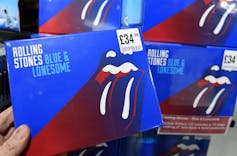
Most Us and Great britain rock and whorl bears the DNA of the delta dejection musicians who innovated the form. Even so, respect was not always paid to these originators past many musicians who often treated information technology as a common property. At that place is a line to be fatigued between respect and disrespect.
Many of us accept marvelled at the Elgin marbles in the British Museum. But how did they come to be there. We tin't properly telephone call Lord Elgin'south removal of the sculptures from the Parthenon theft as there is a dispute over claims that Elgin had legal title from the Ottoman empire. But is this non at the very least cultural appropriation?
If culture is annihilation, information technology is about constructing the meaning of things and events for a grouping – and this is necessarily rooted in place and time. Remove the "culture" from the context and information technology is macerated, or negated. Hence, the example of me wearing a Hijab, or perhaps Elgin displaying the Parthenon marbles in his forepart room. Nonetheless, we commonly accept other positions.
And then, if I have a melody, or an image, or phrase I can employ information technology, sample it, or quote – if I become permission. The rights of the writer extend to control how that cultural thought is expressed, just particularly the context – the concern is to maintain the integrity of the art. This second position is what nosotros might call cultural substitution, based on an agreed usage in a particular context – one that the writer agrees respects the original.
A third possibility is that in that location is a new cultural cosmos formed from a dialogue between the different cultural forms, i that engages with the meanings of the originals and forges new ones from them. Here the cultural product is neither one, nor the other or the originals – nor is it a licensed reuse or copy. This is the essence of inventiveness and how newness enters the world.
Civilisation of creativity
Last month Nike produced a new product, its sport hijab. Is information technology offensive, is it cultural appropriation past a multinational? I'grand not going to judge everybody's response to this, but I think this falls into the 2d category – and maybe the third, a new cultural creation. Information technology was designed in collaboration with hijab wearers and religious authorities, every bit well as Nike.

Perhaps a more radical and innovative human action was the development of the burkini, a classic attempt to have 2 different cultural traditions and introduce at the same fourth dimension. Just every bit with regular swimwear, context is all – wearing it in the office is likely to cause offence.
The debate is not but one of censorship. It is the subject field position that matters (who is proverb or doing the human activity), whose "traditions" or "civilisation" are beingness used – and with whose permission. Culture and meanings practise not be outside order and meanings depend on respecting the views of those concerned. In the Shutz case, this should mean consulting Mamie Till Bradley and the civil rights community. These are the those voices needed to be function of a real fence, rather someone from outside the customs whose idealised notion of what constitutes "censorship" has nothing to practise with the rights or feelings of those concerned.
0 Response to "What Do You Do With Art Stolen From Nonexistne Tcultures"
Post a Comment